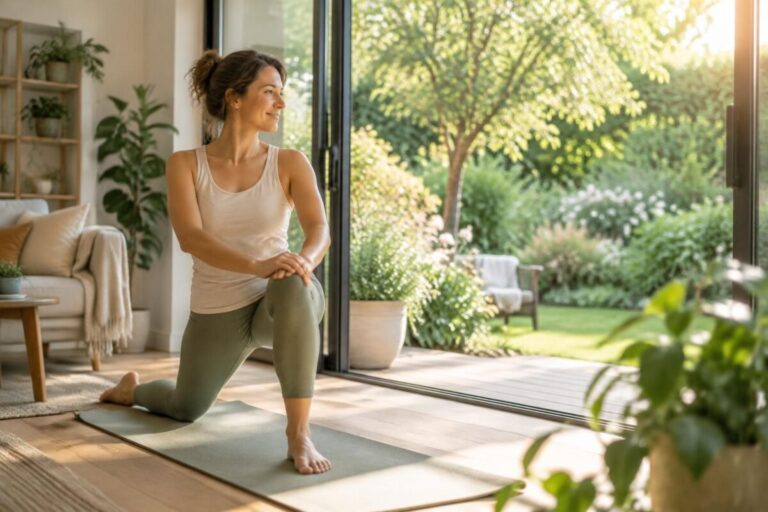
Natural health: gentle exercise or the illusion of slow progress?
Hi, it’s Noémie. Gentle exercise can lead to real progress, provided you practice regularly and choose suitable movements: moving slowly is not a drawback, but it isn’t enough on its own. In natural health, the guiding principle is simple: move with control, without sharp pain or striving for performance. Mobility, balance, and muscle strength can all improve step by step. The effectiveness of the exercises is measured above all by how they help with everyday movements, not by how quickly results appear.
Do this first
- Choose a specific goal: balance, strength, mobility, or relaxation.
- Start with a 10- to 15-minute session at a comfortable pace.
- Have a sturdy chair and a clear space ready, with no slippery mat.
- Breathe normally and reduce the range of motion if a movement pulls too much.
- After the session, note what feels easier, even slightly.
Slow progress can be real progress: standing up more easily, having better control of your footing, or moving with less apprehension are already useful signs. To maintain a lasting routine, you can also read these tips on choosing between intense effort and consistency and this suggestion for protecting your joints with gentle exercise.
Gentle exercise: subtle but tangible progress
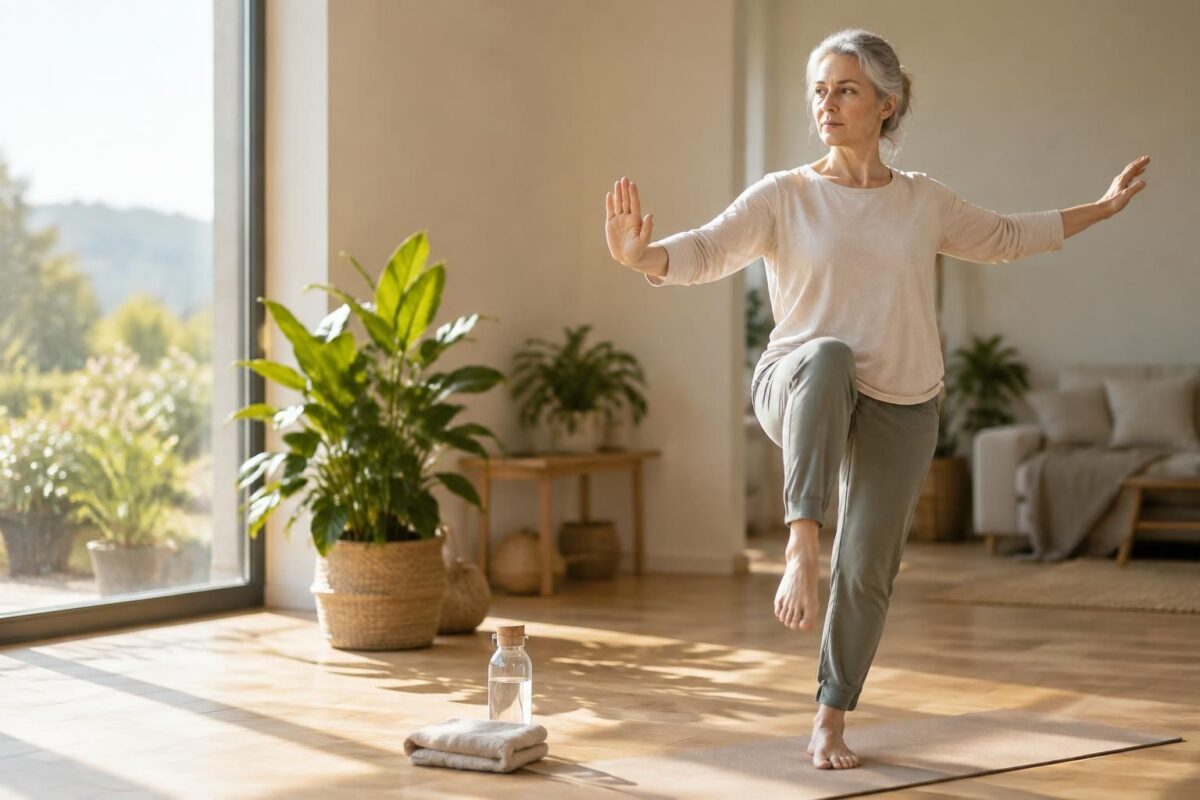
Gentle exercise brings together slow, adaptable movements. It can work on strength, coordination, posture, or flexibility without aiming for maximum effort. However, beginner Pilates, chair exercises, tai chi, and standing movements do not all have the same demands.
A session may seem easy because it involves neither jumping nor heavy weights. Yet slowly standing up from a chair or pushing against a wall already engages your muscles. Gentle does not mean useless or risk-free: technique and fitness level matter more than the name of the class.
A fictional neighbor, Claire, started again with a few chair stands and shoulder movements. After several weeks, she mainly noticed that she could get up from her armchair more easily. “Little by little, the bird builds its nest”: consistency helps make these changes visible.
What progress can you expect from gentle exercise?
Regular practice can help maintain balance, mobility, and the strength needed for everyday movements. The effects depend on the exercises: stretching alone does not replace muscle strengthening, and a very gentle session will not do much to build endurance.
How progress feels also varies. Some people quickly feel more at ease, while others first notice better stability or more comfortable recovery. Gentle exercise does not guarantee weight loss and does not treat chronic pain.
| Your goal | Format to explore | What to check |
|---|---|---|
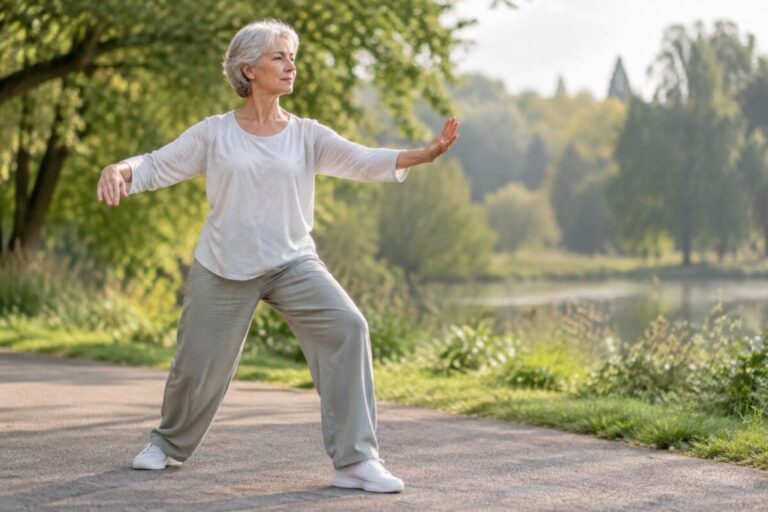
| Improve your balance | Tai chi, qi gong, adapted standing exercises | A stable support nearby |
| Strengthen your core | Beginner Pilates, gentle strengthening | Accessible variations that do not require difficult movements on the floor |
| Restore mobility | Joint mobility exercises, gentle yoga | No forced postures |
| Move with limited support | Chair exercises, adapted activity | A sturdy chair and an appropriate level |
A three-step gentle exercise routine
To get started, ten to fifteen minutes may be enough. This plan is suitable for an adult without acute pain or specific restrictions; it is not a substitute for a rehabilitation program.
- Step 1 — Wake up your body. Sit down and place your feet on the floor. Raise and lower your heels five to eight times, then gently march in place, sitting or standing depending on your balance.
- Step 2 — Strengthen without straining. Do three to five chair stands, controlling the downward movement. Then, with your hands against a wall, do four to eight slow pushes without holding your breath.
- Step 3 — Wind down. Sit down, relax your shoulders, and extend one leg in front of you before lowering it again. Keep the range of motion comfortable and stop if you feel sharp pain.
If you’re starting again after a long break, begin with a short session and repeat it twice during the week. If you already feel comfortable, add a few minutes or one repetition, but change only one thing at a time.
If you have mild muscle soreness after starting again… ease off a little and see how you recover. If you experience sharp pain, feel unwell, or become unusually short of breath… stop the session and seek appropriate advice.
When should you ask for advice before starting?
After surgery or a recent injury, or if an existing condition already limits your activities, ask the healthcare professional who is treating you for advice. Chronic pain also calls for movements and a progression suited to your situation.
Stop if you experience chest pain, feel unwell, suddenly lose your balance, or become unusually short of breath. Moving slowly helps you control your movements, but it does not replace listening to your body’s signals.
Choosing a session and measuring its effectiveness
Before joining a class or following a video, check the stated level and the variations offered. A good instructor explains the movements, lets you adapt them, and does not present pain as a necessary part of the process.
After two or three tries, ask yourself whether you were able to follow along without apprehension, whether you recovered normally, and whether you feel like doing it again. These concrete indicators are more useful than promises of quick results.
Is gentle exercise really effective?
It can help maintain mobility, balance, and strength if the exercises match your goal and are practiced regularly. Progress is often gradual.
How long should I practice to get started?
A first session of 10 to 15 minutes may be enough. Gradually increase the duration or number of repetitions according to how comfortable you feel and how well you recover.
Is gentle exercise suitable for everyone?
It can be adapted, but it is not automatically suitable for every situation. If you have an illness, a recent injury, or persistent pain, seek professional advice before starting.
Does gentle exercise help you lose weight?
It can contribute to a more active lifestyle, but it does not guarantee weight loss. Its main benefits are movement, strength, balance, and well-being.
Thank you for your interest. With friendship; Noémie. P.S. Leave a little comment at the bottom of this page and let me know what you think…